Call for Panels for the Eighth Biennial Conference of the European Rural History Organisation

Call for Panels for the Eighth Biennial Conference of the European Rural History Organisation

Organisers: University of Primorska, Faculty of Humanities

7 – 10 September 2027, Koper, Slovenia

EXTENDED DEADLINE for Panel Proposals: 15 October 2026

The 8th biennial conference of the European Rural History Organisation (EURHO) will be held in Koper – Capodistria, Slovenia, from 7 to 10 September 2027, hosted and organized by the University of Primorska, Faculty of Humanities.

In a relatively short time, the EURHO Rural History Conference has become the central event in this field of study bringing together scholars and students from Europe and other continents. Through the years, after its inception in Brighton (2010), followed by conferences in Bern (2013), Girona (2015), Leuven (2017), Paris (2019), Uppsala (2021/2022), Cluj (2023) and Coimbra (2025), participants have built and strengthened collaborations, discussions and networks that have enabled the steady and fast development of modern rural history research, in particular by addressing the people who lived in the countryside as active actors in history. In recent years, the EURHO conferences have managed to expand the participation of researchers from all regions of Europe, as well as from other continents. The Rural History 2027 conference aims to continue these trends.

Nestled in Koper on the Northern Adriatic coast, the University of Primorska well represents Slovenia's position in Europe, bridging North and South, East and West. Panels will also take place in the premises of the Faculty of Management and of the Faculty of Mathematics, Natural Sciences and Information Technologies. All three faculties are located in the historic centre of Koper, a picturesque coastal town in Northern Istria offering a charming blend of Venetian and Slovenian heritage, historic architecture, and scenic seaside views that make it an enticing destination to explore.

The Rural History 2027 conference website provides information on deadlines, calls for panels and papers, registration, and accommodation. We encourage all participants to apply and register as early as possible.

Researchers working on any aspect of the history of the countryside are invited to submit panel proposals. A panel should focus on a specific topic and include participants from at least two countries. Panel proposals will be assessed by the Conference Scientific Committee which will accept or refuse them, or suggest modifications.

  • Panels may be organized in a single session or in double sessions.
  • A panel session will last two hours and include four papers; a maximum of five papers is possible.
  • Double panels may not exceed eight papers in total.
  • Panels will be led by a chair. In case the panel includes a discussant, it may not exceed four papers.
  • The presentation of new research and of work in progress is particularly relevant. Long-run perspectives and comparative approaches are particularly welcome.
  • Proposals from all the regions and countries of Europe are invited.

A panel proposal may be presented by up to three scholars and should include a title, the full name and affiliation of the organiser(s), a short abstract (up to 500 words) introducing the discussed topic, the area and period it addresses, the approach, as well as the names and affiliations of at least two panel contributors.

The extended deadline for panel proposals is October 15th, 2026.

Before you begin, please ensure you have the contact information and affiliations for all your co-proponents ready. You will receive an automated confirmation email with a link to review or modify your submission once it is complete.
Read more...

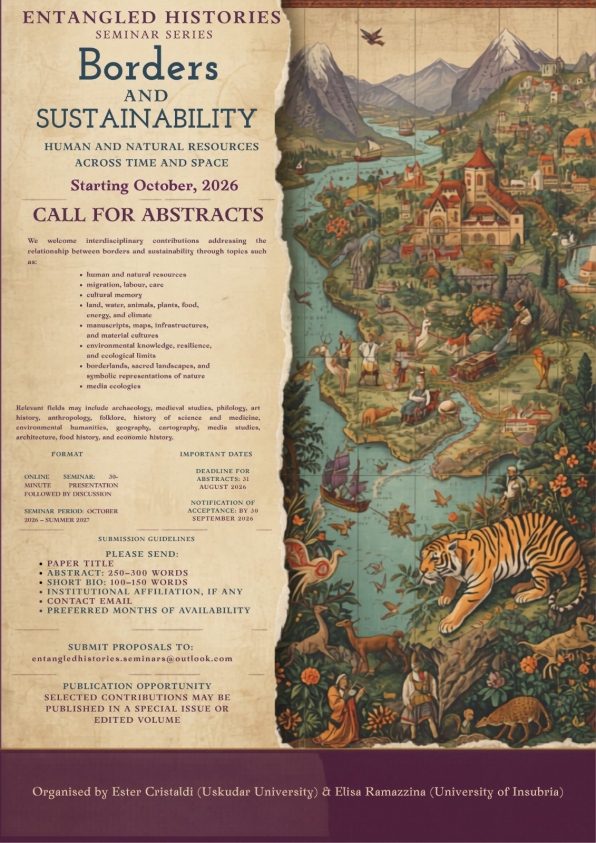
CFP - Borders and Sustainability: Human and Natural Resources across Time and Space (Seminar Series 2026–2027)

Call for Papers: Entangled Histories Seminar Series 2026–2027

Following the success of the current edition, the Entangled Histories Seminar Series invites abstracts for its 2026–2027 cycle: 

"Borders and Sustainability: Human and Natural Resources across Time and Space."

This edition explores sustainability not as an exclusively environmental concern but as a multifaceted concept that intersects with borders across diverse cultural, material, and ecological contexts. 

The series adopts a diachronic and interdisciplinary perspective, spanning from prehistory to the contemporary world.

Sustainability and Borders: A Broad Perspective. We seek to investigate sustainability in its multiple dimensions:

  • Material sustainability: recycling of resources (manuscripts, architectural structures, waste, and landscapes).
  • Ecological sustainability: relationships between humans, animals, and environments; balance between preservation and exploitation.
  • Social, linguistic, and cultural sustainability: transmission of knowledge, endangered languages, healing practices, migration, and community resilience.
  • Symbolic sustainability: representations of ecological limits, hybrid beings, and cultural imaginaries of nature and borders.

Conceptual Framework At the heart of the series lies the concept of borders, understood as dynamic thresholds that shape access to resources and regulate interactions. Borders are not only physical or political: they can be ecological, cultural, social, linguistic, political and material. While we encourage long-term temporalities and global spatial entanglements, we also offer the elements (earth, water, air, fire, ether, wood, etc.) as a possible heuristic framework to explore these dimensions across different historical strata.

Topics of Interest: We encourage contributions from a wide range of disciplines, including but not limited to:

  • Archaeology and Prehistory: Resource use, landscapes, indigenous practices, and environmental interactions over time.
  • Medieval Studies, Philology, and Manuscript Cultures: Material sustainability of manuscripts, palimpsests, intellectual ecologies, literatures and languages, and the transmission of knowledge.
  • Art History and Visual Culture: Representations of nature, landscapes, borders, and material practices across different periods.
  • Anthropology and Folklore: Vernacular ecological knowledge, oral traditions, liminal beings, and environmental imaginaries.
  • History of Science and Medicine: Healing practices, scientific knowledge, and environmental understanding across cultures.
  • Environmental Humanities and Ecology: Human–non-human relations, ecosystems, climate, and resilience.
  • History of Economy, Trade, and Food Systems: Circulation of resources, subsistence, scarcity, and sustainability practices.
  • Architecture and Infrastructure Studies: Built environments, water and soil management, roads, and material borders.
  • Geography, Cartography, and Media Studies: Spatial representation, mapping, and communication of environmental knowledge across borders.

? High-Impact Publication Opportunity: A selection of the most significant contributions will be published in a dedicated edited volume or a special issue with a leading international publisher (past collaborations and ongoing projects include prestigious venues such as Brill, De Gruyter, and Routledge). This ensures that the research presented reaches a global audience of specialists.

Submission Guidelines

  • Format: Online seminar (approximately 30-minute talk + discussion).
  • Schedule: October 2026 – Summer 2027.
  • Required: Title, Abstract (250–300 words), Short Bio (100–150 words), Affiliation, email address, and preferred months of availability.
  • Deadline: 31 August 2026.
  • Send to: This email address is being protected from spambots. You need JavaScript enabled to view it..
Read more...

Curso online: "História, Ambiente e Conhecimento no Antropoceno – edição especial Fogo"

Curso online organizado pela Fiocruz no âmbito do projeto Ecologias Insubmissas (que envolve instituições portuguesas e brasileiras). 
Começa com uma aula do Stephen Pyne no dia 23 de setembro sobre o piroceno e a história planetária do fogo. Depois, são mais 4 aulas (sempre às quarta-feira, pelas 14h do fuso horário em Portugal), que exploram abordagens ao fogo entre história da ciência, história do ambiente, geografias do fogo, e os usos e práticas do fogo.
 
Informaçao e inscrições, aqui: Campus Virtual Fiocruz
Read more...

NEW! Environmental Stories

This month - "Portrait of a Flora: José Quer y Martínez and the Botany of Enlightened Spain (1762-1764)", by Pedro Mota Tavares - REPORT(H)A - Portrait of a Flora: José Quer y Martínez and the Botany of Enlightened Spain (1762-1764)

-----------------------------------------------------

Este mês - "Retrato de uma Flora: José Quer y Martínez e a Botânica da Espanha Ilustrada (1762-1764)", por Pedro Mota Tavares - REPORT(H)A - Portrait of a Flora: José Quer y Martínez and the Botany of Enlightened Spain (1762-1764)

Read more...

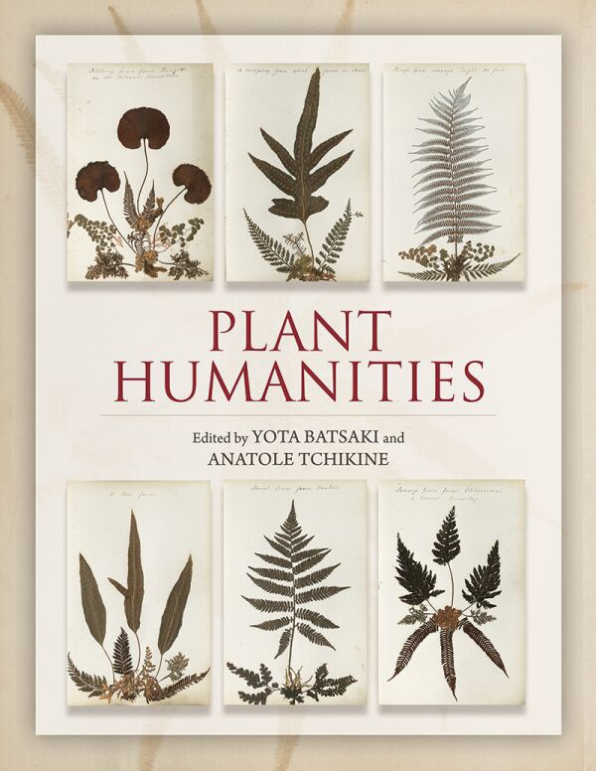
The Plant Humanities edited volume will be available this summer

Plant Humanities, edited by Yota Batsaki and Anatole Tchikine, will come out from Dumbarton Oaks/Harvard University Press in August. This first publication of the Plant Humanities Initiative moves plants to the center of critical inquiry, positioning them as biocultural entities with distinct environmental and social histories.

The book’s introduction describes the key methodological and theoretical parameters of the plant humanities framework. This is followed by thirteen commissioned chapters by scholars across disciplines and covering a broad geographical range—from the Americas, Europe, and the Pacific, to the Indian subcontinent, East Asia, and Africa. Many of them explore the dual character of plants as place makers and world travelers. As ecosystem builders and cultural agents constitutive of national, sacred, and domestic ecologies, plants also help us trace legacies of colonialism and capitalism, and the related challenges of anthropogenic climate change and biodiversity loss.

Plant-focused epistemologies are central to Plant Humanities, with several essays exploring the interplay between vernacular and scientific paradigms and distinct taxonomic systems to reveal instances of rupture, continuity, and resilience.

The book concludes with an essay on the poetics of plants, exploring their foundational role in communal imaginaries and our understanding of the sacred. Collectively, the essays elevate plants as vibrant beings that have profoundly shaped our environments and cultures.

+ info: https://www.doaks.org/newsletter/new-from-plant-humanities#edited-volume
++ info: https://www.hup.harvard.edu/books/9780884025320
Read more...

New issue | HoST — Journal of History of Science and Technology

We are happy to announce the publication of the latest issue of HoST - Journal of History of Science and Technology 

HoST is a peer-reviewed diamond open access journal, published online in English by Paradigm Publishing Services (De Gruyter), and results from a partnership between four Portuguese research units (CIUHCT, CIDEHUS, ICS e IHC).

The full issue is available from this link. Articles can be downloaded separately or as one single compressed folder.


Read more...

Pensar o Parque Natural | Convocatória Arte 2026

A associação Finis Terrae lança uma convocatória aberta para a exposição Pensar o Parque Natural a realizar em Setembro de 2026, acompanhada da edição de um catálogo coletivo.

Artistas – Podem candidatar-se com trabalhos visuais e interdisciplinares, apresentando obras que reflitam sobre a relação entre Natureza, património e comunidade, com especial enfoque no Parque Natural de Sintra-Cascais e nos desafios partilhados por outros Parques Naturais ou sítios UNESCO.

Autores de texto – Escritores, jornalistas, investigadores e ativistas são convidados a propor ensaios, crónicas, reflexões ou testemunhos que dialoguem com os temas da exposição. Os textos selecionados integrarão o catálogo da mostra.

O objetivo é reunir num mesmo projeto imagens e palavras, criando um espaço de partilha e pensamento crítico sobre a defesa do património natural e cultural.

Mais informações em Pensar o Parque Natural | Convocatória Arte 2026 | Finis Terrae

Read more...

CFP - Uncertain Landscapes 2: Beyond the Resources

International Congress Uncertain Landscapes 2: Beyond the Resources, organised by the research unit Lab2PT at the University of Minho, which will take place in Guimarães, Portugal, from 24 to 26 November 2026. The call for papers is currently open until 31 May 2026.
The conference will address landscape as a conceptual tool to rethink our ways of inhabiting the world, to challenge disciplinary boundaries in the search for responses to contemporary issues concerning the relationship between human beings and the spaces they inhabit, and as an instrument for imagining diversified futures grounded in the knowledge of the past, while acknowledging the permeability of territory and respect for the environment.
We welcome proposals for abstracts and papers from academics, practitioners, theorists, and researchers working in areas such as architecture, landscape architecture, archaeology, visual arts, design, media and communication studies, history, sociology, anthropology, cultural studies, art history, photography, geography, geology, the natural sciences, and any other related fields of research.
 
The conference is structured around six thematic areas:
  1. BEYOND HERITAGES: Invisibility of Memories and Visibility of Process
  2. BEYOND PARADIGMS: Complexity, Epistemological Ruptures, and the Untold Story
  3. BEYOND (AB)USE: Landscapes of Care
  4. BEYOND THE URBAN: Old Geographies with New Ways of Making
  5. BEYOND THE SURFACE: Regenerative Practices
  6. BEYOND PROGRESS: Embracing Cooperation, Slowness, and Indeterminacy
Read more...
Subscribe to this RSS feed

About REPORT(H)A

News & Events